Data Driven Immersive Analytics, for collaborative / remote personalized analytics environments excels in academic excellence
An online brain-computer interface for detecting incongruity in augmented reality applications
This paper presents a hybrid brain-computer interface that combines EEG and eye tracking to detect when AR information conflicts with a user’s expectations (incongruity). Two experiments demonstrate that the N400 event-related potential is reliably elicited when users fixate on incongruent AR content, and that online classification achieves approximately 70% balanced accuracy. The approach enables autonomous system adaptation, such as providing additional context or flagging unexpected information, without restricting natural gaze behavior.
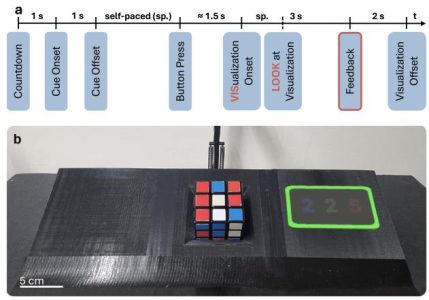
This paper was accepted to the Journal of Neural Engineering. It demonstrates that gaze deployment can be used as event marker for online detection of incongruity in augmented information.
Wimmer, M., ElSayed, N., Thomas, B. H., Müller-Putz, G. R., & Veas, E. E. (2026).
An online brain-computer interface for detecting incongruity in augmented reality applications. Journal of Neural Engineering, 23(3), 036024.
Academic ambition
Five papers have been submitted and are currently under review.
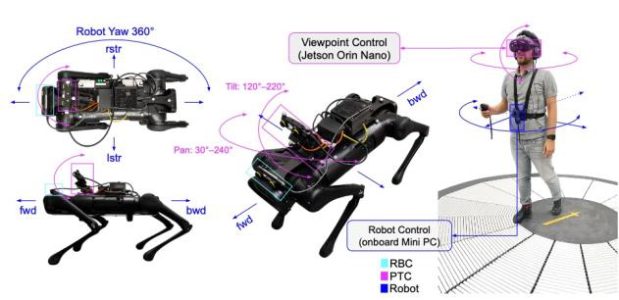
Effects of Locomotion and Viewpoint Control on Immersive Robot Telepresence for Navigation and Inspection.
This paper investigates how locomotion (joystick vs. omnidirectional treadmill) and viewpoint control (joystick vs. head-guided) affect performance and user experience in a VR telepresence task with a quadruped robot navigating a maze. Results show that head-guided camera control significantly improves task performance, reduces workload, and enhances presence and usability, regardless of locomotion mode. The study concludes that viewpoint control is more critical than locomotion for telepresence quality in combined navigation and inspection tasks.
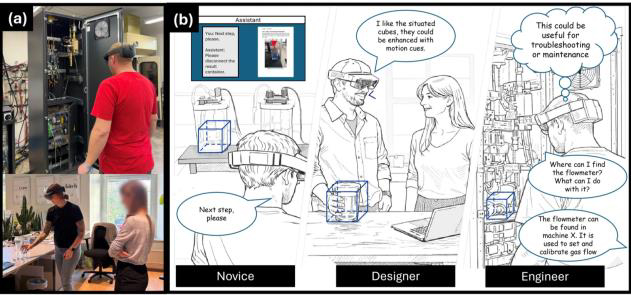
Designing Conversational AR Assistants for Industrial Tasks: A Qualitative Study with Novices and Domain Experts.
This paper presents a qualitative evaluation of a conversational AR assistant that combines document-grounded LLM responses with spatial visual cues for industrial procedures. Through studies with novices, UI/UX designers, and a testbed engineer, the assistant was valued for reducing documentation search, but usability challenges with floating panels and multimodal interaction were identified. Findings suggest that conversational AR should evolve toward a spatially integrated, multimodal task assistant rather than a floating chatbot interface.
Comparing Situated Linear and Radial Time Series Visualizations in Virtual Reality.
This study compares linear and radial line charts in a situated VR visualization context, using a juice mixer scenariowith historical sensor data. Two tasks evaluated performance: one focused on data interpretation, the other on observing both charts and the environment. Linear charts generally outperformed radial charts in performance and user preference, though radial charts influenced gaze deployment and reporting strategies without affecting overall performance in the context-aware task.
Asymmetric Multi-Scale MR-VR Collaboration: A Study of Tabletop Avatar Gaze Control.
This paper introduces a novel asymmetric MR-VR collaboration setup where a remote expert uses a tangible prop to control a miniature avatar’s gaze within a tabletop World-in-Miniature. Three interaction methods (VR immersion, floating screen with head control, and on-prop touchpad) were evaluated in two maintenance tasks. VR generally outperformed in performance and user experience, while the tabletop avatar control was positively received for supporting collaboration, highlighting design opportunities for gaze control in MR remote-expert scenarios.
Situated Analytics in the Wild: Research Directions for Intelligent, Collaborative, and Adaptive Analytics.
This paper presents a conceptual framework for deploying Situated Analytics (SA) in dynamic real-world environments, derived from a workshop with 25 interdisciplinary experts. The framework comprises five interdependent layers: collaborative interaction, multimodal dashboards, context-aware system response, task-space adaptation, and intelligent data and AI. The paper formulates key research directions for enabling adaptive, collaborative analytics beyond controlled laboratory settings.
Two Doctoral candidates defended with success.
Dr. Michael Wimmer defended on the 11.06.2026 his PhD thesis in the field of Biomedical Engineering entitled “Hybrid Brain-Computer Interfaces for Error Detection in Virtual and Augmented Reality”, cosupervised by Prof. Gernot Müller-Putz and Priv.Doz.Dr Eduardo Veas.
This thesis contributes to the development of adaptive immersive systems that can:
i) Detect and correct errors during human-computer interaction in VR,
ii) Proactively assist users when AR information appears unclear or counterintuitive,
iii) Flag system errors for improved reliability and user experience,
iv) Bridge the gap between laboratory BCI research and practical realworld applications,
v) Leverage HMD-integrated sensors (eye tracking, pupil size) for enhanced BCI performance without additional setup complexity.
All contributions are compiled in 5 core publications.
Dr. Ammaar Zaman defended on the 03.07.2026 his PhD thesis in the field of Computer Science, entitled “Designing for Spatial Coherence in Immersive Environments“, supervised by Priv.Doz.Dr. Eduardo Veas.
The thesis investigates how immersive systems can sustain accurate spatial understanding across changing perceptual, cognitive, and embodied constraints.
This thesis contributes to the design of adaptive immersive systems by demonstrating that:
i) Perceptual support should be scene-compatible and robust under changing operator state,
ii) Embodied interaction should be evaluated by coordination quality, not naturalism alone,
iii) Telepresence design should prioritize reducing viewpoint-management overhead,
iv) Spatial coherence provides a consistent framework for evaluating immersive systems across
perceptual, cognitive, embodied, and remote-action contexts
Project partners: AlphaGate Automatisierungstechnik Gesellschaft m.b.H, Austria, Andritz AG, Austria, IMERYS Talc Austria GmbH, Austria, Siemens Aktiengesellschaft
 This success story was provided by the consortium leader and by the mentioned project partners for the purpose of being published on the FFG website. Know Center Research GmbH is a COMET Centre within the COMET – Competence Centers for Excellent Technologies Programme and funded by BMK, BMDW as well as the federal states Styria, Vienna and Tyrol. The COMET Programme is managed by FFG. Further information on COMET: www.ffg.at/comet