Women in Research at Know Center: Meet Dr. Nicki Lisa Cole
Science is not created in isolation. It is shaped by people, institutions, values and lived experiences. In our new Women in Research series, we introduce researchers at Know Center and explore what drives their work, how they found their way into science, and what changes they hope their research can contribute to.
For our first interview, Barbara Gstöttenmayr from the Know Center Communication Team spoke with Dr. Nicki Lisa Cole, sociologist and researcher in the field of metascience, with a focus on inequality, open science, sustainability and AI.
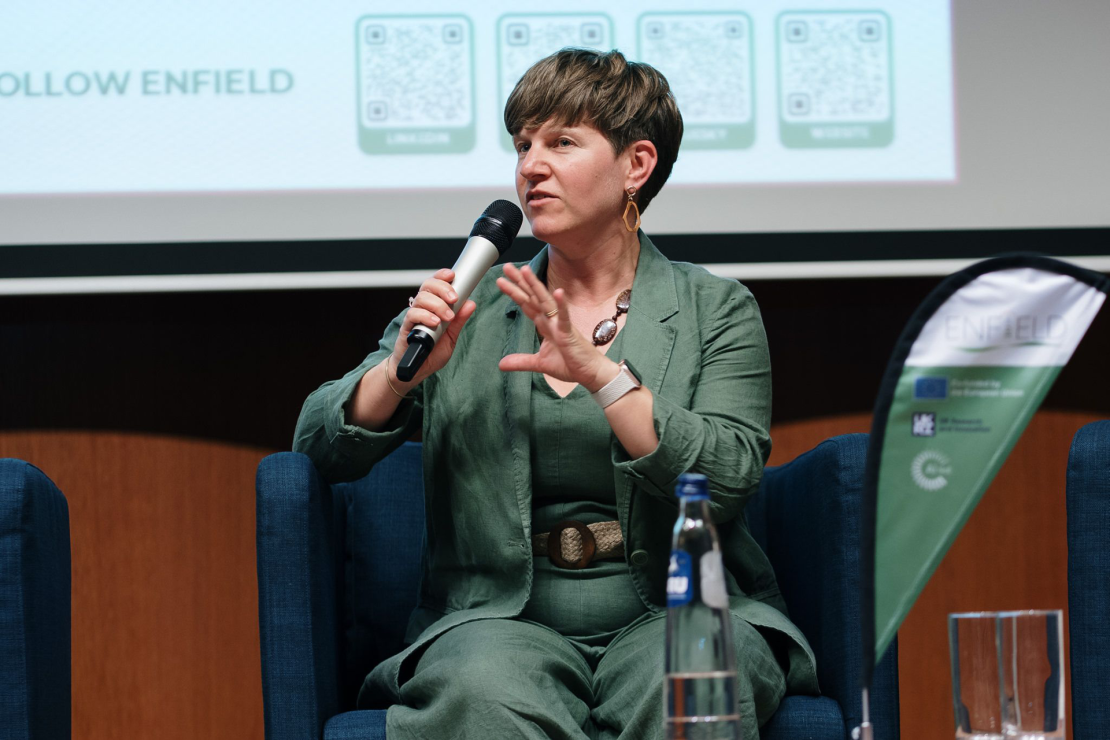
Nicki Lisa Cole at an ENFIELD conference // © ENFIELD PROJECT
What does your research focus on?
How would you describe your work to someone outside academia?
At the core of my work is a passion for understanding and addressing inequality. That has been a constant throughout my career, even as my specific research topics have changed.
Today, I work in metascience, sometimes described as the science of science. I study how inequalities appear within research and innovation systems: who gets to ask research questions, whose perspectives are represented, and how these structures influence the knowledge and technologies we create.
This matters because science and innovation shape the world around us. If research communities are not diverse and inclusive, the resulting knowledge, products and technologies may fail to reflect the needs of society as a whole.
Why diversity in research and innovation matters
How have research systems changed over the past decades?
It depends a lot on the field, the region and the institutional context. Some disciplines have made significant progress in terms of inclusion and diversity, while others still remain relatively homogeneous.
In many STEM fields, for example, we still see that women and other underrepresented groups are less visible, especially in senior positions. This is often described as a “leaky pipeline”: women may be well represented at early stages of education, but their numbers decrease at later career stages.
That has consequences. Research questions, methods and innovation processes are influenced by the people who design them. If only a narrow group of people is involved, certain perspectives and needs may be overlooked.
From sociology to metascience
What first drew you to sociology?
I discovered sociology in my first year at university in California. At the time, I thought I would study English literature because I had always loved reading. But something did not quite click.
Then I took an introductory sociology course, almost by chance, and it immediately made sense to me. Sociology gave me a way to understand how individual experiences connect to broader social patterns: family structures, cultural trends, political systems and inequalities.
It helped me see that many things we experience personally are also shaped structurally. After one semester, I knew I wanted to study sociology.
Research paths are rarely linear
Was there an unexpected detour that shaped your path as a researcher?
My earlier work as a sociologist focused on consumer culture, branding and global supply chains. My PhD research looked at coffee, especially the relationship between ethical marketing and the realities faced by coffee farmers. Later, I also worked on electronics and supply chains.
That work eventually brought me to Graz through a research fellowship on a project about Apple computers. Later, after living in England and returning to Austria, I applied for a position in the Open and Reproducible Research team at Know Center.
At first, metascience was a completely new field for me. I had to learn a new research area and find my place within it. In a way, it felt like starting over academically. But it also opened up a new space where my background in sociology became highly relevant.
A researcher between New Hampshire, California and Austria
Where did you grow up, and how did that influence you?
I grew up in New Hampshire in the northeastern United States, in New England. It is a very green, mountainous and mostly rural area. My family was very outdoors-oriented: hiking, cycling, skiing. In that sense, parts of Austria feel familiar to me.
I later moved to California for university and stayed there for my studies and early career. California had a very strong influence on me, both academically and personally. It was a place where I found sociology and began shaping my path as a researcher.
What does your role at Know Center look like today?
What do you spend your time on in practice?
Until recently, my main focus was research: leading research tasks, conducting qualitative work and contributing to projects within the Open and Reproducible Research team.
Over the past year, my role has shifted more towards research management and strategic development. That includes networking, writing funding proposals, supervising research, and developing a new research cluster around feminist metascience and AI studies.
It is a transition: I am still involved in research tasks, while also taking on more responsibility for shaping future directions. That balance can be challenging, but it is also exciting.
Feminist metascience and AI studies
Which research questions are you most excited about right now?
A lot of my current work revolves around inequality, power dynamics, diversity and science-based innovation. I am interested in how specific research fields or innovation environments create or reproduce inequities — and how we can change that.
In AI, this is especially important. AI systems increasingly affect many areas of life. But the teams, datasets and institutions behind these systems do not always reflect the diversity of society. That raises questions about whose needs are considered, who benefits, and who may be disadvantaged.
My goal is to better understand these dynamics and contribute to more inclusive research and innovation practices.
Open Science, fairness and inclusion
What misconception about open science would you like to change?
A common misconception is that open science is just another administrative requirement for researchers. And in some contexts, it can feel that way: data management plans, open access requirements, documentation obligations.
When I first encountered some of these practices, they did not always feel well aligned with qualitative research. Many open science frameworks were initially designed with quantitative research in mind.
But over time, I learned that open science can be much more flexible and creative than it first appears. It can make research more transparent, more robust and more useful. For me, opening up parts of the research process — documenting methods, making decisions visible, reflecting on data practices — can improve the quality of the work.
The key question is not simply: “Is this research open?”
It is: “Open for whom, under which conditions, and with what consequences?”
Sustainable AI beyond efficiency
How does sustainability connect to your research?
For me, sustainability is also an equity issue. Environmental impacts are not distributed equally. Often, communities with fewer resources are more strongly affected by negative environmental and social consequences.
In the context of AI, a lot of discussion focuses on Green AI: making models more computationally efficient, reducing energy consumption and lowering climate impact. That is important, but it is only one part of the picture.
We also need to ask broader questions: Where does the hardware come from? How is it produced? What environmental and social impacts are connected to infrastructure, data centers and supply chains? And what are AI systems ultimately used for?
This is why I argue for a broader understanding of Sustainable AI. It is not only about efficiency. It is about the entire system around AI and how it can contribute to the public good.
Research with real-world impact
What real-world change would you like your research to contribute to?
I would like to support more inclusive and reflective practices in research and innovation, especially in the tech sector.
At Know Center, we work closely with company partners. I see an opportunity to help organizations understand the broader implications of their work: sustainability, equity, inclusion and social impact.
That means looking not only at the final product or technology, but also at the processes behind it. Who is involved? Which assumptions guide development? Whose needs are considered? How can innovation become more inclusive from the start?
Ultimately, I would like my research to contribute to technologies that better represent and serve society as a whole.
Trustworthy AI needs inclusive processes
How does this connect to Trustworthy AI?
Trustworthy AI is not only a technical question. Of course, robustness, data quality, privacy and security are essential. But trust also depends on whether people can see their needs, perspectives and concerns reflected in the systems that affect them.
That means we need to think about trust across the entire research and innovation process. Inclusive participation, transparency, accountability and social responsibility all matter.
For me, this is where metascience, open science and Trustworthy AI strongly connect.
Women in Science: support, confidence and community
What has helped you thrive and remain confident as a woman in research?
Other women have been incredibly important. Not exclusively, of course, but having women colleagues and peers to talk to, share experiences with and receive support from has made a real difference.
It matters to have people who listen, understand and support you when changes need to be made. It also matters to see women in scientific leadership. Representation can be reassuring because it shows that an organization values different paths, perspectives and contributions.
I also have a small network of women colleagues in the open science and qualitative research community. We support each other, celebrate successes and help each other through difficult moments. That kind of community is essential.
Advice for young researchers
What advice would you give to young women or anyone who feels they do not fit the traditional image of a scientist?
Find your community. Find people who believe in you, support you and help you develop the confidence to pursue your own research questions.
Academic research can be very personal. Our identities often become connected to our work, especially when our research grows out of our own experiences or values. That can make criticism difficult, but it can also make the work deeply meaningful.
It is important to know why you want to do this work and to surround yourself with people you trust. Most researchers experience self-doubt at some point. That does not mean you do not belong. It means you need support, perspective and people who remind you of the value of your work.
Curiosity beyond research
What keeps you curious outside of work?
These days, a lot of my curiosity is connected to parenting. I enjoy learning about childhood development, education and how different approaches affect children. I have always had a researcher’s mindset, so I naturally like to understand how things work and how knowledge can be applied in everyday life.
Another area is gardening. We have a garden now, and I have been learning about cultivation, companion planting and how different plants support each other. It is very satisfying to learn something, apply it and see the results directly.
What makes a good researcher?
What qualities do you admire in other researchers?
I really admire researchers who can communicate clearly. Someone can be highly intelligent and do excellent scientific work, but if they cannot explain it in a way that others can understand, the impact remains limited.
Good communication can happen in many settings: at a conference, in a classroom, in a project meeting or in a conversation with family. What matters is clarity. I admire people who can make complex ideas accessible without oversimplifying them.
For me, that is a crucial part of good research: not only producing knowledge, but making it meaningful and understandable to others.
About the Women in Research series
Initiated by Barbara Gstöttenmayr, the Women in Research series highlights researchers whose work shapes the future of data science, artificial intelligence and trustworthy technologies. The series offers personal insights into scientific careers, research questions and the people behind the projects.