AI development is accelerating. AI models are evolving into AI agents, gaining the ability to actively and autonomously act, based on capabilities to plan and to utilise tools and other AI systems. This increases the usefulness of AI, but crucially also increases the associated risks.

Billions are being invested, anticipating the ability of AI to transform and streamline countless business operations across many domains. Current research focuses largely either on building more capable AI models, or on human-computer interaction in isolation.

We go beyond the state-of-the-art by holistically investigating the interfaces and connections between AI agents and other actors such as humans, as well as more passive technological components such as IoT devices and knowledge bases. Hence, the title of our module: Interfaces of Agent-Centric Artificial Intelligence (IACAI).
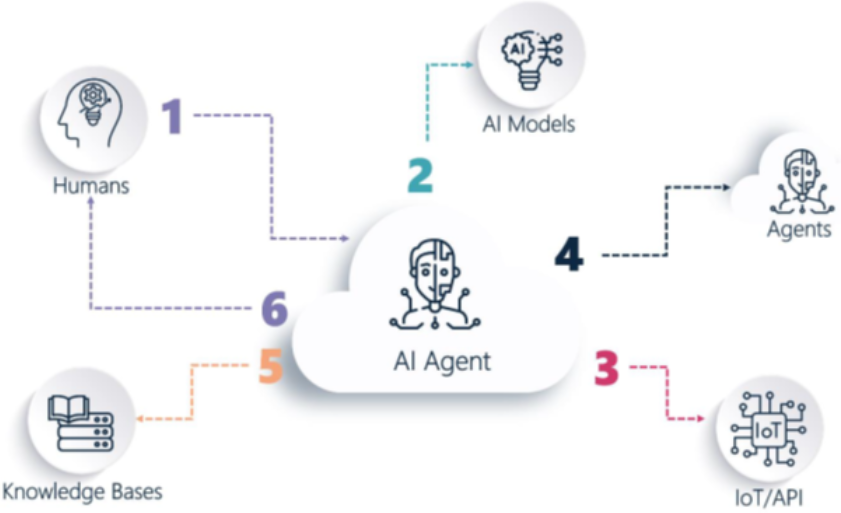

Interfaces of Agent-Centric AI (IACAI)

Vision and strategy

IACAI will address (i) algorithmic and computing, (ii) human-computer interaction, as well as (iii) social and ethical considerations regarding a future, agent-centric AI.  

To overcome major algorithmic, computational and implementation impediments for (generative) AI in collaborative agent scenarios our research will include work on foundations of efficient data transfer and management across actors, improving the computational efficiency of AI models, and boosting the reasoning capabilities of AI models.  

To overcome issues of productivity when humans use AI in complex tasks, partially due to the unresolved question of how humans can understand decisions in multi-stakeholder networks, we will investigate how to improve human-AI synergetic task performance via interaction designs that use explicit domain knowledge and will develop algorithms and interfaces for traceability of AI decisions in multi-agent environments.  

To inform socially responsible and ethical technology design, we will model actors, interaction and agency to analyse, on theoretical and empirical levels, how interactions and interfaces in agent-centric AI shape the notions of responsibility and trust, and will develop algorithms to ensure fairness and diversity in resource distribution and decision-making in the future agent-centric AI that we are envisioning.  

Methods and approach

Research conducted in this module will draw from and make contributions to research on large-scale data management, machine learning, natural language processing, knowledge modelling, human-computer interaction, information visualisation, explainability, science and technology studies, and bias and fairness in AI.  

We will contribute to make agent-centric AI more correct, more reliable, more resource-efficient, and more efficient in supporting humans conduct complex tasks.  

Research within IACAI will be guided by a code of conduct, which will be one of the initial outcomes of the module. Environmental and societal impact will be continuously assessed and documented. 

Outcomes

The outcomes of IACAI will be a series of prototypes and guidelines on how to implement agent-centric AI.  

IACAI will establish agent-centric AI that fulfils technical requirements, as well as conforms to ethical standards as imposed by society and achieves trustworthiness expected by its users.  

Overall, the project seeks to realise agent-centric AI that is technically robust, resource-efficient, transparent, ethically aligned, and genuinely supportive of humans in complex tasks. 

Facts and figures

  • Start date: 01.01.2026
  • End date: 31.12.2029
  • Total budget: €3.750.000

Scientific partners

  • Technische Universität Berlin – Berlin Institute for the Foundations of Learning and Data (BIFOLD)
  • Big Data Engineering Group (DAMS Lab)
  • Universität Graz – Institut für Ethik und Gesellschaftslehre
  • Technische Universität Graz – Institute of Human-Centred Computing (HCC)
  • Technische Universität Graz – Institute of Software Engineering and Artificial Intelligence (SAI)
  • Technische Universität Graz – Institute of Visual Computing (IVC)
  • FH OÖ Forschungs & Entwicklungs GmbH

Industry partners

  • DaphOS GmbH
  • KEBA Group AG

The COMET Module is funded within COMET – Competence Centers for Excellent Technologies – by BMIMI, BMWET  as well as the co-financing federal province of Styria. The COMET programme is managed by FFG.

Interfaces of Agent-Centric AI (IACAI)